


Industrial Aluminum CNC Machining: Solar to Rail Transit

Industrial aluminum parts are no longer only about simple frames or basic cut lengths. If you supply solar frames, rail transit parts, automation frames, guide rail profiles, or equipment structures, your customer usually checks three things first: hole position, batch consistency, and assembly fit. That is where CNC machining for industrial aluminum profiles becomes a serious production choice.
MALIDE focuses on intelligent aluminum alloy equipment and complete automated equipment for real factory use. For buyers, the useful point is not just that the company offers machines. It is that its product range covers profile machining centers, gantry machining centers, horizontal profile machining centers, drilling and milling units, and cutting systems.
The company information also shows a 6,000 m² production base, more than 50 staff members, and over 5,000 cooperation cases, which gives industrial buyers a clearer sense of production depth and service capacity. Its self-developed three-axis and four-axis machining centers are described as high-precision, efficient, and stable equipment for aluminum alloy processing.
Why Does CNC Machining Matter for Industrial Aluminum Profiles?
When you process long aluminum profiles, the headache is rarely just one hole. It is the relationship between every hole, slot, end face, and threaded point. If a solar frame has uneven mounting holes, installation slows down. If a rail transit component has poor side-hole accuracy, the whole assembly may need rework. Not dramatic, but expensive.
Stable Positioning for Long Workpieces
A dedicated CNC profile machining center helps reduce repeated manual positioning. This matters in industrial aluminum profile processing, especially when the same part needs drilling, milling, tapping, chamfering, and slot work.
The knowledge base lists BT30 and BT40 profile machining centers with X-axis travel options from 2500 mm to 6500 mm, while BT40 models are used in rail transit, aerospace, linear module guide rails, and communication fields.
Better Batch Consistency
For batch orders, you do not want the first 20 pieces to look fine and the next 200 pieces to drift. Aluminum profile CNC machining gives you more repeatable hole spacing and cleaner slot positions. It also makes production easier to track, which helps when a buyer asks for the same part again two months later.
Where Can Industrial Aluminum Profile CNC Machining Be Used?
The biggest value appears when you move beyond ordinary frame work. Higher-value customers often need a mix of speed, clean edges, and repeatable accuracy. This is why industrial aluminum profile machining fits solar energy, rail transit, automation equipment, machinery frames, and motion systems.
Solar Frames and PV Mounting Profiles
For solar frame machining, the main work often includes mounting holes, drainage slots, angle cuts, and clean edges. In large PV projects, small errors become very visible because the same profile may repeat across thousands of sets. A stable aluminum profile cutting saw and an aluminum profile drilling and milling machine can help keep the assembly line moving without too much hand correction.
Rail Transit Aluminum Components
Rail transit aluminum profile machining asks for stronger process control. Long profiles may need repeated mounting holes, side slots, and connector areas. A BT40 or gantry-style solution is often more suitable because the workpiece is heavier and the part tolerance is less forgiving. Nobody wants to discover a hole pattern issue after parts reach the assembly site.
Automation Frames and Guide Rail Profiles
For automation frame CNC machining, accuracy affects how fast technicians can build machine guards, conveyor frames, robotic cells, and equipment bases. For linear guide profile machining and aluminum guide rail CNC machining, hole spacing and side features affect motion stability. A small offset can create noise, uneven wear, or extra adjustment work during installation.
Which CNC Processes Should You Plan For?
Before buying equipment, you need to list your real processes instead of only asking for machine size. Different parts need different combinations. Some jobs only need drilling and milling. Others need tapping, chamfering, end-face work, and multi-side access.
Drilling, Milling and Tapping
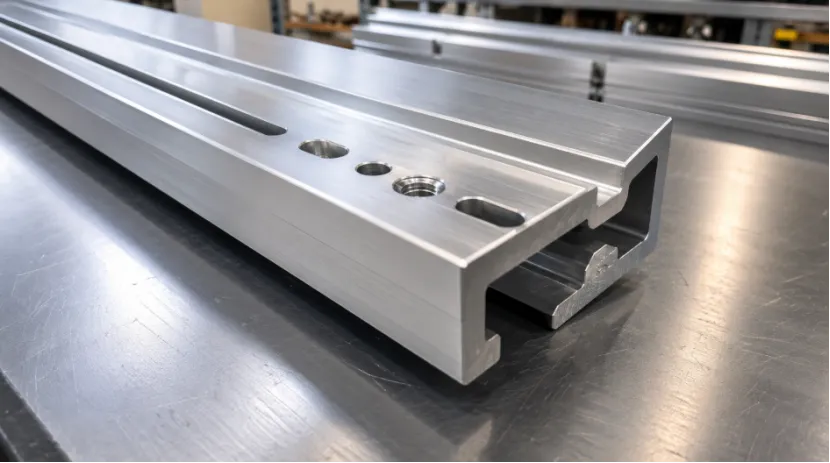
Aluminum profile drilling handles mounting holes and locating holes. Aluminum profile milling creates slots, openings, flat areas, and irregular holes. Aluminum profile tapping supports threaded connections for automation frames, solar brackets, and equipment structures.
The knowledge base describes drilling and milling machining centers that process circular holes, slot holes, chamfering, flat carving, and optional tapping, with 90°/0°/-90° three-side servo flipping and 6-tool or 12-tool capacity options.
Chamfering and End-Face Machining
Aluminum profile chamfering helps remove sharp edges and improves assembly feel. Aluminum profile end face machining is also important when profiles must connect tightly. A horizontal aluminum profile machining center or end face milling machine can be a better fit when end surfaces and side features matter more than simple top-face work.
How Should You Choose a CNC Profile Machining Center?
Choosing equipment is easier when you match the machine to your part family. A short profile with simple holes does not need the same structure as a long rail part. Start from workpiece length, face count, hole pattern, batch size, tool number, and clamping style. You can also compare the Profile Machining Center category when planning a new production line.
Three-Axis, Four-Axis and Gantry Choices
A three axis aluminum profile machining center fits standard holes, slots, and flat machining. A four axis aluminum profile machining center is better when you need angles, side features, or more complex shapes. For large parts, a CNC gantry machining center gives more space and stronger support.
The knowledge base lists a three-axis model with 7000 mm X-axis travel, 24000 r/min speed, and gantry frame structure. It also notes that the four-axis model can process curved surfaces, angles, and irregular profile shapes that are hard for three-axis machines.
FAQ
Q1: What is CNC machining for industrial aluminum profiles?
A: It is the use of CNC equipment to drill, mill, tap, chamfer, cut, and machine end faces on industrial aluminum profiles used in solar frames, rail transit parts, automation frames, guide rails, and machinery structures.
Q2: Which machine is better for solar frame machining?
A: For solar frame machining, you usually need an aluminum profile drilling and milling machine, an aluminum profile cutting saw, or both. The best choice depends on hole quantity, profile length, and daily output.
Q3: When should you choose a four axis aluminum profile machining center?
A: Choose it when your part needs multi-side aluminum profile machining, angled holes, side slots, or complex shapes that require fewer manual turns.
Q4: Is a CNC gantry machining center suitable for rail transit aluminum profile machining?
A: Yes. A CNC gantry machining center is often suitable for large aluminum profile machining, long workpieces, repeated hole patterns, and heavier industrial parts.
Q5: How can aluminum profile machining accuracy reduce assembly problems?
A: Better aluminum profile machining accuracy helps holes, slots, and end faces match during assembly. It reduces rework, saves fitting time, and makes CNC machined aluminum profiles easier to install in batch projects.


