



Machine Aluminum Profiles Before or After Anodizing? A Process-Planning Guide
Machine before anodizing when the specified finish must cover the newly created features and the finishing process can meet the final drawing. Machining pre-anodized profiles is a different route because cutting removes the existing finish at those features, so exposed surfaces must be acceptable or receive an approved treatment. Choose the sequence from the finished-part requirements, including appearance, protection and fit.
Neither route is automatically suitable for every extrusion. A visible frame, an internal mounting rail and a precision sliding interface can need different surface conditions. Decide those conditions before releasing the machining program or buying a batch of finished stock.
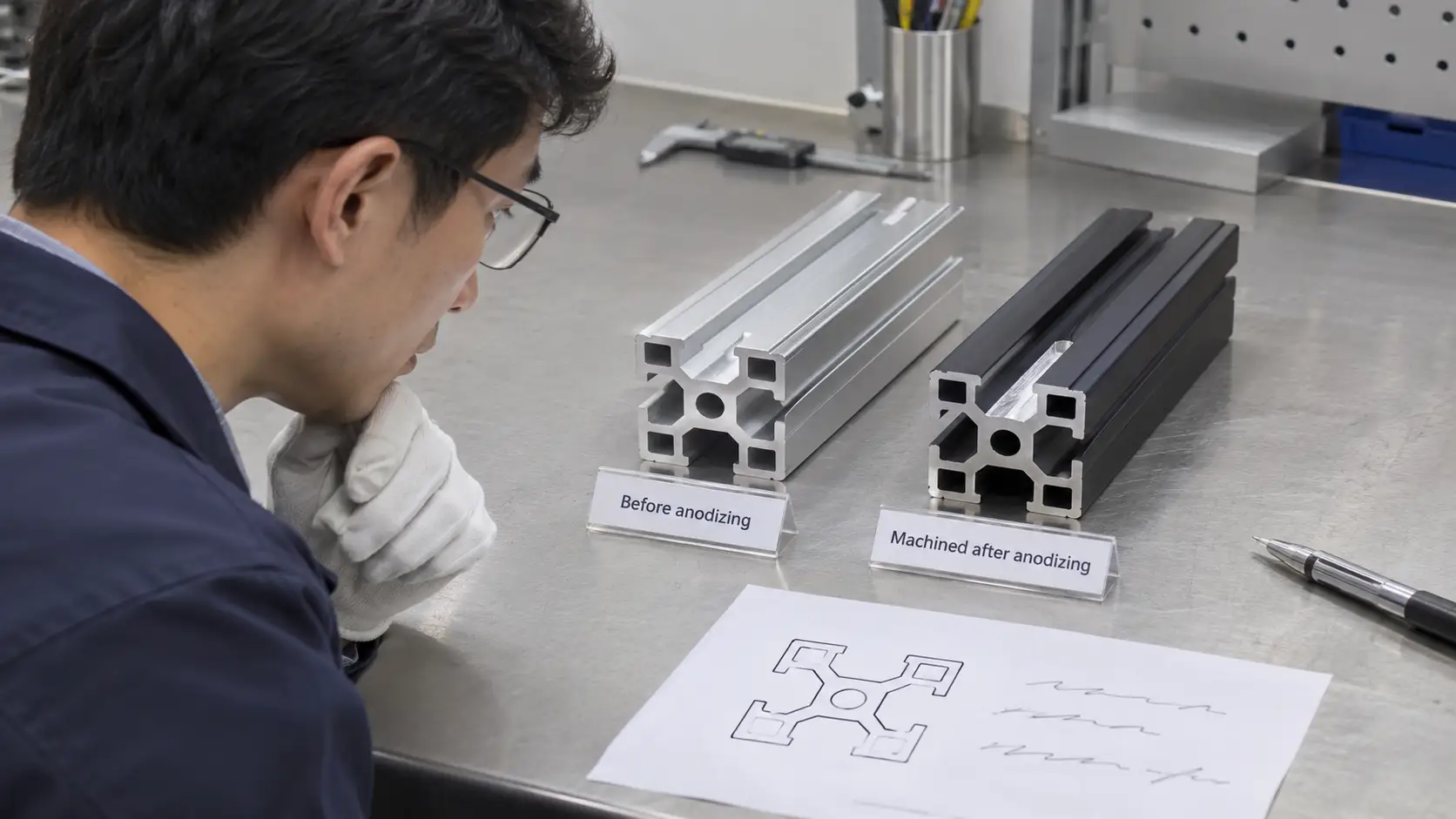
Map the finish requirement to each machined feature
List the holes, slots, cut ends and contact faces on the part drawing. The profile drilling and milling configuration supports milling and chamfering. Tapping is optional. Each operation needs a defined place in the manufacturing route, rather than a general instruction to anodize the part somewhere before delivery.
For every feature, identify whether the surface must be anodized, may remain uncoated or must meet a separate functional condition. Mark the visible faces and the areas hidden after assembly. A hidden cut can still have a protection requirement; visibility alone does not decide acceptance.
State the material and finish specification with the required color and inspection condition. Keep the machining supplier, finisher and responsible designer working from the same drawing revision. An exterior color sample cannot define the treatment of an internal bore or threaded feature.
What machining before anodizing changes
This route creates the geometry first, then sends the part through the agreed finishing sequence. It allows newly machined surfaces to be considered together with the rest of the profile for the required coating, subject to the finisher’s process and access review.
Prepare the surface to the agreed condition before it leaves machining. Anodizing follows the existing texture; it should not be expected to conceal scratches or machining marks. Where brushing or another mechanical preparation is required, establish its direction and extent before the finishing order is released.
Discuss handling and electrical contact locations with the anodizer. The finishing process needs a practical way to hold and contact the part. Agree which locations are acceptable for contact marks and whether any fixture holes or other features are needed. Do not leave that decision until a visible face has already been marked.
The finished result still needs inspection. Passing a machined dimension before anodizing does not establish the corresponding finished dimension or final appearance.
What machining pre-anodized stock changes
The incoming extrusion already carries its finish. Drilling a hole or milling a slot removes that layer where the tool cuts. The new surface can differ in appearance from the surrounding anodized face. Record whether that contrast and the resulting surface condition meet the product requirement.
Keep the clamp and support arrangement consistent with the finished surface. Check pads, stops and locating faces for contamination, and prove that handling does not leave unacceptable marks. Any protective material also needs checking for effects on seating, clearance or the subsequent process.
Plan deburring around the coating boundary. Removing an edge burr can also disturb the adjacent finish, so define the acceptable edge appearance and method through a representative sample. A large chamfer may look deliberate on one design and unacceptable on another.
If exposed areas require protection, obtain an approved treatment plan from the responsible designer and finishing specialist. Local treatment must not be assumed to reproduce the original anodized coating, color or specified performance.
Resolve dimensional effects before choosing the route
Anodizing changes the surface condition and can affect effective dimensions. Pretreatment may also remove material. Ask the finisher to review the coating system and preparation against the critical features; do not apply one generic allowance to every hole, slot and outer face.
Identify the inspection stage for each critical dimension. Where a bore or mating surface must meet its final requirement after finishing, the machining and finishing plans need to explain how that will happen. Possible routes include an agreed machining allowance, a specified uncoated area or an approved operation after finishing.
Those choices solve different requirements. Masking preserves an uncoated region where the drawing allows it. Machining after anodizing also leaves a newly cut surface. Neither is a substitute for a specified anodized functional face unless the designer approves the resulting condition.
Check threaded features and mating parts as part of this review. Define whether the thread is inspected before or after finishing, and obtain the appropriate process allowance or exclusion from the responsible specialists. Do not change a thread tool merely because an unrelated finished sample felt tight.
Compare routes by the condition they deliver
|
Planning question |
Machine before anodizing |
Machine pre-anodized stock |
|
Newly created surfaces |
Included in the finishing review |
Existing finish removed at the cut |
|
Appearance |
Machining texture and finishing preparation must be agreed |
Cut edges and adjacent coating need acceptance criteria |
|
Critical dimensions |
Allow for the specified finishing process |
Verify final cuts and any later treatment |
|
Workholding |
Protect the required incoming and outgoing condition |
Prove handling against the existing finish |
|
Release evidence |
Inspect after the full finishing route |
Inspect machined areas and retained coated surfaces |
Compare the actual supply arrangements too. If stock arrives pre-anodized, changing to a post-machining finish may require a different purchasing and handling route. Confirm that the finisher can process the real section and finished length, rather than assuming every profile accepted by the CNC machine fits the downstream operation.
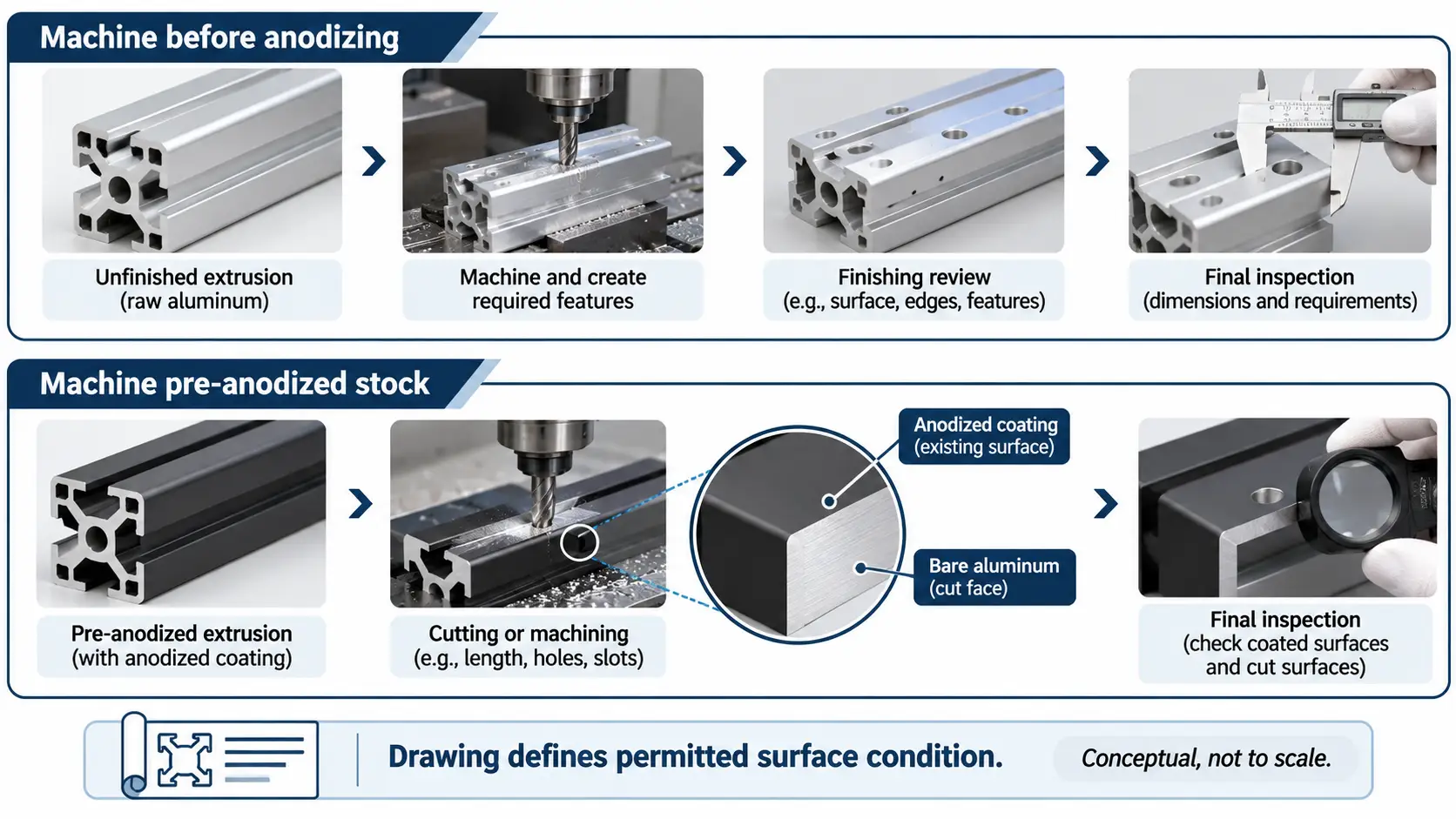
Prove the sequence on a representative profile
Use the specified alloy, section, incoming finish and critical features for the trial. Include a visible edge, a relevant mating feature and any surface whose treatment is restricted. Keep the material identity, drawing revision and route with the sample.
For a new machine purchase, the profile machining acceptance trial can establish the machining and handling results. Final finishing acceptance remains a separate check after the agreed downstream process. A good freshly machined sample cannot demonstrate an anodized color or finished fit that has not yet been produced.
Inspect the characteristics that govern the route choice in their final condition. Compare appearance under the agreed viewing conditions and measure the critical dimensions with the specified method. Retain an approved reference sample where practical, including its permitted cut-edge and contact-mark conditions.
If the result fails, identify which stage changed it. Review the machined condition, handling, preparation and finishing records before changing the CNC settings. An undocumented correction at one stage can hide the cause and leave the next batch dependent on the same adjustment.
Put the approved route into purchasing and inspection
Once a sample is approved, record the sequence in the job documentation. Specify the incoming stock condition, machining revision, required preparation and finishing operation. Attach the feature map showing coated and permitted uncoated areas. Purchasing should order the condition that the process plan actually assumes, including whether the supplier delivers unfinished or already anodized profiles.
Carry identification through the handoff to the finisher. Record which machined batch belongs to which order and retain the agreed sample reference. If appearance must match across an assembly, tell the finisher which components will be viewed together. Approving one isolated piece leaves that assembly requirement unanswered.
Define what happens when the route changes. Substituting pre-anodized stock for unfinished extrusion, changing the preparation or moving a final cut after finishing can alter the delivered surface. Have the responsible parties review the affected features before releasing the revised batch. A purchasing substitution can therefore need process approval even when the nominal section dimensions match.
Give incoming inspection requirements and the agreed exceptions. The inspector should be able to identify a permitted bare cut, a restricted contact mark and a defect requiring review from the same controlled record. Keep the accepted sample traceable to its route and drawing revision so that it remains meaningful when a repeat order arrives. Review any changed requirement with machining, finishing and quality personnel before using the previous sample to release new production.
FAQ
Must every aluminum profile be machined before anodizing?
No. The sequence follows the drawing and supply route. Pre-anodized stock can be machined when the resulting cut surfaces and retained finish satisfy the approved requirements.
Will anodizing hide cutter marks or scratches?
Do not rely on it. Define the required surface preparation before finishing and approve a representative sample. Existing texture and defects can remain visible in the anodized result.
Can a critical hole simply be masked?
Only if the specified final surface condition permits it. Agree the masking boundary and dimensional verification with the designer and anodizer before treating it as the approved route.
Is a locally treated cut equivalent to the original anodizing?
Do not assume equivalence. The required protection, appearance and acceptance method must be reviewed for the proposed treatment by the responsible specialists.
For a Malide machining review, share the incoming finish and final-part requirements with the section drawing and proposed sequence. Ask for workholding and sample-machining checks, while confirming the anodizing specification and final finishing acceptance with your designer and anodizer.


