



Machining Large EV Battery Trays: How to Control Distortion
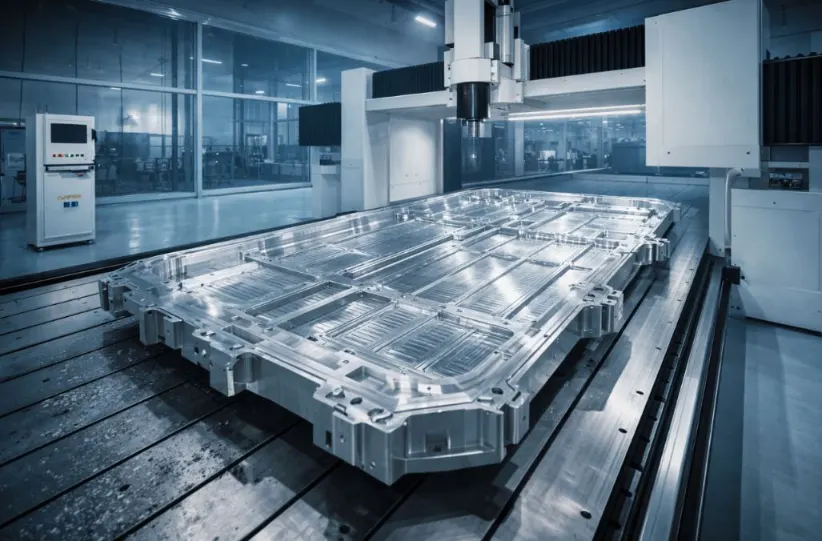
Electric vehicle battery trays and enclosures are increasingly designed with lightweight aluminum components. However, machining large aluminum parts presents several challenges, particularly when maintaining dimensional accuracy, flatness, and structural stability.
During CNC machining, material removal can release residual stress, while cutting forces, heat accumulation, and improper workholding may cause the workpiece to deform.
For manufacturers producing EV battery components, controlling distortion requires more than selecting a powerful CNC machine. The machining strategy, fixture design, material condition, and machine configuration must work together.
This guide explains the main causes of aluminum machining distortion and the practical factors manufacturers should consider when selecting CNC machining equipment.
Why Thin-Wall Aluminum Trays Distort
Before you can fix the problem, you need to respect the physics of the material. Aluminum extrusions are excellent for creating the long, structural shapes needed for EV chassis, but they react aggressively to machining forces. What happens inside the metal when your end mill hits it determines whether you get a good part or a piece of scrap.
Residual Stress Release
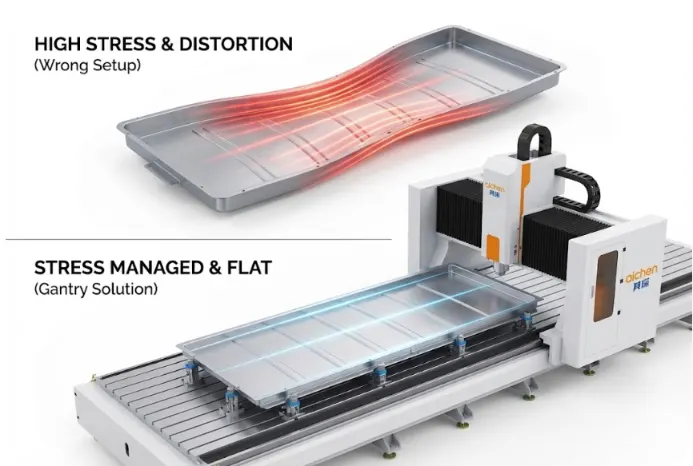
Aluminum materials may contain residual stresses from upstream manufacturing and heat-treatment processes. During CNC machining, removing material unevenly can redistribute these internal stresses and cause the workpiece to bend, twist, or lose dimensional accuracy. For large aluminum components, a balanced machining sequence is important. Removing excessive material from one side before machining the opposite side may increase the risk of distortion. Manufacturers should evaluate the material condition, machining allowance, workholding arrangement, and cutting sequence before beginning production.
Heat and The “Nesting Doll” Problem
Heat generated during CNC machining can cause localized thermal expansion in aluminum components. Once the workpiece cools, dimensional changes may occur, affecting flatness and machining accuracy.
This is particularly important when machining large aluminum battery enclosures with thin walls or precision sealing surfaces.
To minimize thermal deformation, manufacturers should select appropriate cutting parameters, maintain stable machining conditions, and verify critical dimensions after the workpiece reaches a stable temperature.
Vibration and Chatter
Thin-wall aluminum components are sensitive to cutting forces and vibration. Excessive tool overhang, insufficient workpiece support, unsuitable cutting parameters, and unstable clamping can all contribute to chatter.
Chatter may affect surface finish, dimensional accuracy, and the quality of critical sealing surfaces.
The required surface roughness should always follow the customer’s engineering drawing and application requirements rather than applying one universal Ra value to every battery tray.
Choosing the Right CNC Machine for Large Aluminum Components
Selecting a CNC machining center for large aluminum components requires careful consideration of the workpiece dimensions, machining envelope, machine rigidity, and workholding requirements.
A gantry machining center can be a suitable solution for certain large-format aluminum machining applications because its structural design can provide a stable platform for machining larger workpieces.
However, machine selection should not depend on X-axis travel alone. Manufacturers should also evaluate Y-axis and Z-axis travel, effective table dimensions, workpiece weight, fixture clearance, and tool accessibility.
Considering BT40 Gantry Machining Centers
For manufacturers evaluating CNC equipment for new energy vehicle components, the MALIDE BT40 Series Gantry Machining Center offers X-axis travel of 3000mm, Y-axis travel of 2000mm, and Z-axis travel of 800mm.
Its configuration supports drilling, tapping, and milling operations for aluminum alloy and other materials.
The appropriate machine configuration should be confirmed according to the actual component drawing, machining requirements, and workholding arrangement.
Machining Strategies for Reducing Aluminum Distortion
1. Proper Workholding and Fixture Design
Workholding plays an important role in machining large aluminum components. Insufficient support may allow thin-wall sections to vibrate, while excessive clamping force may deform the workpiece before machining begins.
Fixture design should consider the component geometry, support locations, cutting forces, and machining sequence.
Depending on the workpiece structure, mechanical clamping, vacuum fixtures, or hybrid workholding solutions may be evaluated and validated before production.
2. Balanced Roughing and Finishing
Removing too much material from one area can create an imbalance in internal stress and increase the risk of deformation.
A staged machining strategy is recommended:
-
Roughing: Remove material in a balanced sequence while maintaining sufficient machining allowance.
-
Semi-finishing: Allow the component to stabilize and inspect critical dimensions.
-
Finishing: Apply controlled finishing passes to achieve the required dimensional accuracy and surface quality.
The actual machining allowance and cutting parameters should be determined through material testing and process validation.
3. Temperature and Process Stability
Temperature changes can affect both the aluminum workpiece and the CNC machine.
Maintaining stable workshop conditions, selecting appropriate cutting parameters, and using suitable coolant strategies can help improve dimensional consistency.
Critical dimensions should be inspected under controlled measurement conditions to ensure reliable results.
Battery Tray Bodies vs. Extruded Aluminum Side Rails
An EV battery enclosure may include a large tray body and separate extruded aluminum structural rails.
These components require different machining approaches.
Battery tray bodies require sufficient machining space, stable workholding, and support for large or thin-wall sections.
Long extruded aluminum rails require suitable profile machining equipment, accurate positioning, and access to the required machining surfaces.
MALIDE specializes in CNC equipment for downstream aluminum profile and component machining. Our CNC profile machining centers are designed for machining aluminum profiles rather than performing the upstream aluminum extrusion forming process.
Conclusion: Precision is the Only Option
In the electric vehicle supply chain, the margin for error is effectively zero. A distorted battery tray isn’t just a cosmetic issue; it is a safety risk. As automakers push for longer range, trays are getting bigger and walls are getting thinner to save weight.
Investing in a large-format gantry machine isn’t just about handling this one job. It opens the door to machining busbars, bumper beams, and structural rails. Don’t let distortion eat your profits. Upgrade to a process designed for automotive tolerances.
Partnering for Production Success
If you are looking for a partner who understands the specific headaches of aluminum processing—from the sticky chips to the vibration of thin walls—Foshan Malide Intelligent Equipment Co., Ltd. is the name you should know. Based in Foshan, the global hub of aluminum extrusion, MALIDE has spent years perfecting machines that do one thing exceptionally well: processing aluminum profiles and long-format industrial parts.
Unlike generic machine builders who try to cut everything from steel to plastic, MALIDE’s engineering is hyper-focused. Our QCL-CNC Series (Gantry Machining Centers) is practically the industry standard for manufacturers dealing with EV battery trays and curtain wall profiles. They understand that for a 3-meter long workpiece, a 0.1mm error is a disaster. That is why they use heavy-duty integrated steel beds and premium components like Schneider electrics and Liming reducers to ensure stability. Whether you need a nimble cutting saw for window frames or a 7-meter beast for automotive chassis parts, MALIDE delivers European-level precision without the excessive price tag. Partnering with specialized aluminum equipment manufacturers ensures you get not just a machine, but a complete process solution tailored for automotive tolerances.
FAQ
Q1: Why can’t I just use my standard VMC and move the part halfway through?
A: You can try, but the risk is high. Every time you unclamp and move a long battery tray, you lose your “zero” reference point. This usually leads to a visible step or mismatch in the middle of the part. For an EV battery sealing surface, that step will likely cause a leak check failure.
Q2: Do I really need a 7-meter machine if my parts are only 2 meters long?
A: Think about throughput. A 7-meter bed allows you to set up “pendulum machining.” You can machine two 2-meter trays on the left side while your operator is unloading and loading new parts on the right side. The spindle never stops, and you basically double your daily output.
Q3: My thin walls chatter when I try to run fast. What’s wrong?
A: It is likely a combination of tool length and machine rigidity. If your machine is a cantilever style, the head might be vibrating. Switching to a gantry structure usually fixes this because the bridge support absorbs that energy. Also, try using a variable helix end mill to break up the harmonic vibration.
Q4: Is a vacuum table strong enough to hold heavy aluminum cutting?
A: For finishing and light roughing, absolutely. For heavy hogging (removing lots of material), we often use a hybrid approach: vacuum for the base stability and low-profile side clamps for the heavy lateral forces. It’s all about surface area—more contact means better grip.
Q5: How do you handle the massive amount of chips from digging out a battery tray?
A: That is a huge issue. A battery tray is 80% air by the time you are done. You need a machine with an aggressive chip conveyor and high-volume coolant flush. If you don’t get those chips out, you will recut them, which ruins the surface finish and breaks tools.


