



6-Tool vs. 12-Tool CNC Aluminum Profile Machining Centers
The main difference between 6-tool and 12-tool CNC aluminum profile machining centers is how many tool assemblies can remain loaded. A six-position magazine accommodates a smaller resident tool set; twelve positions provide more space for different cutters and spare assemblies. That difference affects tool preparation and job changeovers. It does not, by itself, change spindle power, machining accuracy, axis travel, or the time needed to cut a feature.
An aluminum profile machining center may use several tools to complete one extrusion, or reuse a few tools across many features. The useful comparison therefore starts with the tool sequence and magazine mechanism, then considers what changes when the next profile enters production.
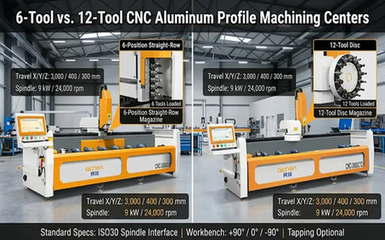
Tool capacity and magazine layout are separate differences
Six and twelve describe nominal storage capacity. Straight-row and disc describe the arrangement of those positions. These are separate characteristics: a tool count alone does not identify the magazine mechanism used by every manufacturer.
A straight-row magazine places tool assemblies along a row. A disc magazine arranges positions around a rotating carrier. The exchange sequence depends on the machine design, including where the magazine sits and how the spindle reaches the exchange position. Neither arrangement has a universal speed advantage.
As a concrete example, Malide’s six-tool aluminum profile machining center uses a straight-row magazine, while its twelve-tool configuration uses a disc magazine. The following specifications apply to these two configurations rather than every six-tool or twelve-tool machine.
|
Specification |
Six-tool example |
Twelve-tool example |
|---|---|---|
|
Tool magazine |
6-position straight row |
12-tool disc |
|
X/Y/Z travel |
3,000/400/300 mm |
3,000/400/300 mm |
|
Spindle interface |
ISO30 |
ISO30 |
|
Listed spindle speed |
24,000 rpm |
24,000 rpm |
|
Listed spindle power |
9 kW |
9 kW |
|
Workbench orientations |
+90°, 0°, -90° |
+90°, 0°, -90° |
|
Tapping |
Optional |
Optional |
The magazine differs while these listed machining specifications remain the same. Final machine configurations and operating limits remain subject to the agreed technical specification.
The difference within a single machining program
If a program needs four compatible tool assemblies, both magazine sizes can potentially hold its complete set. Six positions then leave two nominal spaces; twelve leave eight. Unused spaces do not shorten drilling or milling time.
If a program requires eight distinct assemblies, six positions cannot store the complete set simultaneously. Completing that process would require a validated alternative, such as splitting operations or replacing tools at a controlled stop. Twelve positions may accommodate the set without that interruption, provided tool dimensions and spacing permit it.
Count assemblies rather than feature types. Two holes of different diameters may require two drills, while many identical holes can share one drill. A tool that reaches a shallow slot may be unsuitable for another slot requiring more reach. Finishing requirements can also justify a separate cutter.
The difference appears when the required set exceeds usable capacity. Below that point, other parts of the machining cycle may determine the result.
The difference between jobs and profile families
One program’s tool count can understate the capacity needed across a shift. Several profiles may each require five tools yet share only some of them. Their combined resident set can exceed six positions.
Consider a hypothetical schedule with the following tool requirements. The numbers describe a planning example, not a tested production result.
|
Tool requirement |
Profile A |
Profile B |
|---|---|---|
|
Shared assemblies |
Four |
The same four |
|
Additional assemblies |
One drill |
Two different drills |
|
Tools needed for each profile |
Five |
Six |
|
Combined set across both profiles |
Seven assemblies |
Seven assemblies |
Each profile individually fits within six nominal positions, but the combined seven-tool set does not. Moving between them requires at least one assembly change on a six-position magazine. A twelve-position magazine could retain the combined set if the layout permits.
For long batches, that replacement may occur infrequently. With frequent alternation between profiles, it becomes a recurring changeover task. This is why batch sequence matters as much as the number of tools in an individual program.
Spare-tool storage and automatic substitution differ
A larger magazine leaves more potential positions for duplicate cutters. These spare assemblies can be useful when a cutter wears or when a finishing tool must remain separate from roughing work.
Storage space does not establish automatic substitution. Tool-life tracking, selection of a replacement assembly, offset handling, and restart logic depend on the control and program. An operator may still need to inspect the part and intervene.
The distinction is between having a spare assembly already loaded and having a verified process that can use it automatically. Both require confirmation beyond the magazine’s stated capacity.
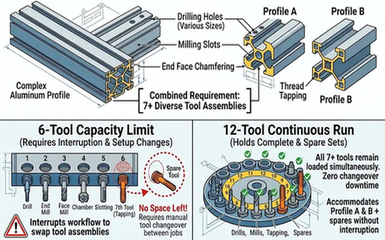
Usable positions depend on tool dimensions
Nominal capacity assumes a permitted tool arrangement. Actual occupancy depends on cutter diameter, assembly length, weight, and clearance through the exchange path. A tool set that appears to fit by count may fail the physical layout check.
With either magazine, usable capacity depends on the spacing between tool assemblies and clearance throughout the exchange movement. Twelve positions allow a larger set only when those assemblies fit the permitted layout. Neither tool count alone establishes the allowable cutter diameter or length.
For a meaningful comparison, map the intended assemblies onto each magazine and verify the complete exchange movement. This establishes usable capacity for the actual tool set, rather than assuming that every nominal position is available.
Tool changes and machining time are different measurements
More storage positions can reduce manual replacements between operations or jobs. They do not necessarily reduce the duration of an automatic exchange.
The interruption between cutting operations can include spindle deceleration, travel to the exchange position, magazine positioning, release and pickup, return movement, and spindle acceleration. A timing figure that measures only the mechanical exchange covers a narrower interval than the time until cutting resumes.
Compare equivalent intervals using the same tool sequence and machining locations. A result taken beside the magazine may differ from a change involving travel from the opposite end of a long profile.
Complete part time also includes loading, locating, clamping, face changes, unloading, and any required manual work. If the same tools remain loaded on both machines, the larger magazine may make little difference to those activities. Where manual replacements interrupt the process, its capacity may have a more visible effect.
Tool count does not determine face access or accuracy
Magazine capacity describes stored tooling. Face access depends on axis arrangement, workbench movement, fixtures, and clearance. A twelve-tool machine does not gain additional machining faces merely by carrying six more tools.
In the two configurations compared above, both workbenches provide +90°, 0°, and -90° orientations. Their listed spindle interface, travel, speed, and power also match. These common specifications keep the magazine difference distinct from other machine characteristics.
Finished-part accuracy still requires evaluation of the machine, fixture, tools, program, stock, and measurement method. Neither six nor twelve positions establishes a tolerance. More tools cannot resolve a clamp blocking a feature, a profile moving under load, or an unsuitable cutter reaching too far beyond its holder.
Maintenance differences also follow the actual construction. Compare the specified cleaning, lubrication, inspection, and recovery procedures for each mechanism. Tool count alone does not establish service frequency or maintenance cost.
The tooling inventory changes as well. Filling twelve positions instead of six involves more assemblies to identify, measure, and maintain. Leaving positions empty avoids that additional inventory until the process needs it. The magazine capacity and the number of purchased tools therefore need not be identical.
For setup records, distinguish the physical pocket from the tool identity used in the program. Moving an assembly between positions can require changes to the control’s tool mapping. The required procedure depends on the control; it should follow the machine documentation for each magazine arrangement.
FAQ
Is a twelve-tool machine twice as fast?
No. It has twice the nominal magazine positions in this comparison. Any output difference depends on the process and the interruptions that additional capacity actually removes.
Can a six-tool machine complete a profile with many holes?
Yes, potentially. Many identical holes can use one drill. Tool demand depends on diameters, reach, operations, and finishing requirements rather than hole count alone.
Does twelve-tool capacity include automatic spare-tool management?
Not necessarily. Magazine storage and automatic replacement are separate functions. The latter requires suitable control features, offsets, and a validated program.
What gives the clearest comparison between the two sizes?
Use the same profile drawing and tool list, then record usable positions, manual replacements, automatic exchange interruption, and complete part time. Those observations show which differences affect the actual process.


