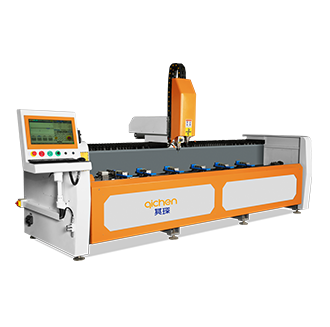
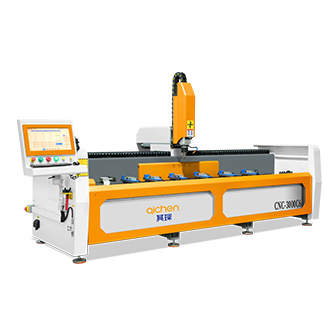
Aluminum Profile Machining with the QCL-CNC3000C2
The machine handles drilling, milling and chamfering of round holes, slots, lock holes and shaped holes on aluminum profiles. Three-sided processing in a single clamping suits profiles with features distributed across three faces — common in door, window and curtain-wall sections.
Key Features
Three-sided flip workbench. One clamping covers three machining faces, which cuts re-clamping cycles and the positional error each re-clamping introduces. Relevant when hole patterns must stay aligned across faces.
Automatic lifting door. The door contains chips and protects operators during machining while remaining convenient to open for loading.
Drilling and milling units. A drilling and a milling machining unit switch within the program so both operation families run in one setup.
Applications
- Door and window profiles: lock holes, handle slots, drainage slots and hardware holes across three faces.
- Curtain-wall profiles: mullion and transom hole patterns with cross-face alignment requirements.
- Industrial aluminum profiles: frames and structures machined on three sides without part flipping by hand.
Choosing the Right Setup
Send the profile drawing showing which faces carry features. If your parts need only two faces, the QCL-CNC3000C2’s flip table still reduces handling; if you need more tool capacity per program, compare the QCL-CNC3000C6 and QCL-CNC3000C12. Provide material, tolerances and production volume for configuration review.
Frequently Asked Questions
What does three-sided flipping mean for my parts?
Features on three faces are machined after one clamping, which saves handling time and keeps features aligned across faces.
Which profiles is the QCL-CNC3000C2 designed for?
Industrial aluminum alloy, door and window, and curtain-wall profiles requiring drilling, milling or chamfering. Confirm your section from the drawing.
How does it differ from the QCL-CNC3000A2?
The QCL-CNC3000C2 uses three-sided flipping for door/window/curtain-wall work; the T2 uses a four-workstation cyclic layout aimed at custom-home profiles. Compare by part type and workflow.
What information is needed for a quotation?
Model, material, workpiece dimensions, required operations, tolerance targets and production target, plus drawings, destination country and site utilities.