



Why Batch Consistency Breaks Down in Aluminum Profile Machining
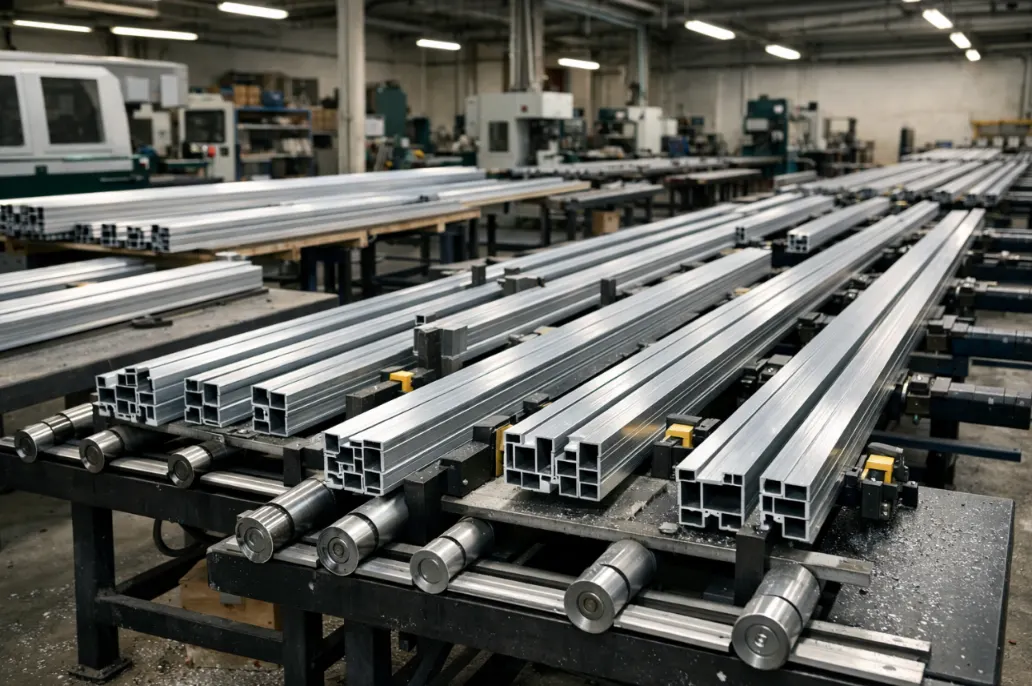
Batch problems rarely announce themselves with a clear failure. More often, they appear as mixed signals. One operator flags a finish change. Another notices hole depth feels inconsistent. Measurements still pass on paper, but confidence drops. In aluminum profile machining, this is how batch consistency starts to break down—not because the program is wrong, but because the process no longer behaves the same from part to part.
This kind of variation is hard to diagnose because nothing is completely out of tolerance. Instead, small shifts in clamping, temperature, material response, and reference position combine over time. What looks like a series of unrelated issues is usually one stability problem showing up in different ways.
Why Single-Part Accuracy Does Not Guarantee Batch Stability
One good part proves a process can hit tolerance. It does not prove the process can repeat it 200 times. Batch stability needs more than a correct toolpath. It needs stable referencing, stable clamping, and stable conditions across the whole run.
The Difference Between Hitting Tolerance Once and Repeating It
A single part can land in spec even if the setup is fragile. The operator loads it “just right,” the fixture is clean, the clamps bite evenly, and the tool is fresh. In a batch, that fragile setup gets tested. Tiny changes in seating, force, and contact points become visible in measurements.
Why Early Parts Often Look Fine
At the start, everything is neat. Chips have not packed into contact surfaces. Clamp pads have not glazed. The machine is still close to its cold state. Even an aluminum profile cutting machine can deliver accurate single cuts early on, yet batch consistency may still break down once profiles move into secondary machining steps and re-clamping becomes routine.
Small Variations Accumulate Across a Production Run
Batch problems often feel random because the drift is slow. A run does not “fail” at one moment. It degrades as small factors pile up. If the shop floor has ever watched two people argue over whose tape is wrong, that is usually a symptom, not the cause.
Fixture Wear and Contact Surface Changes
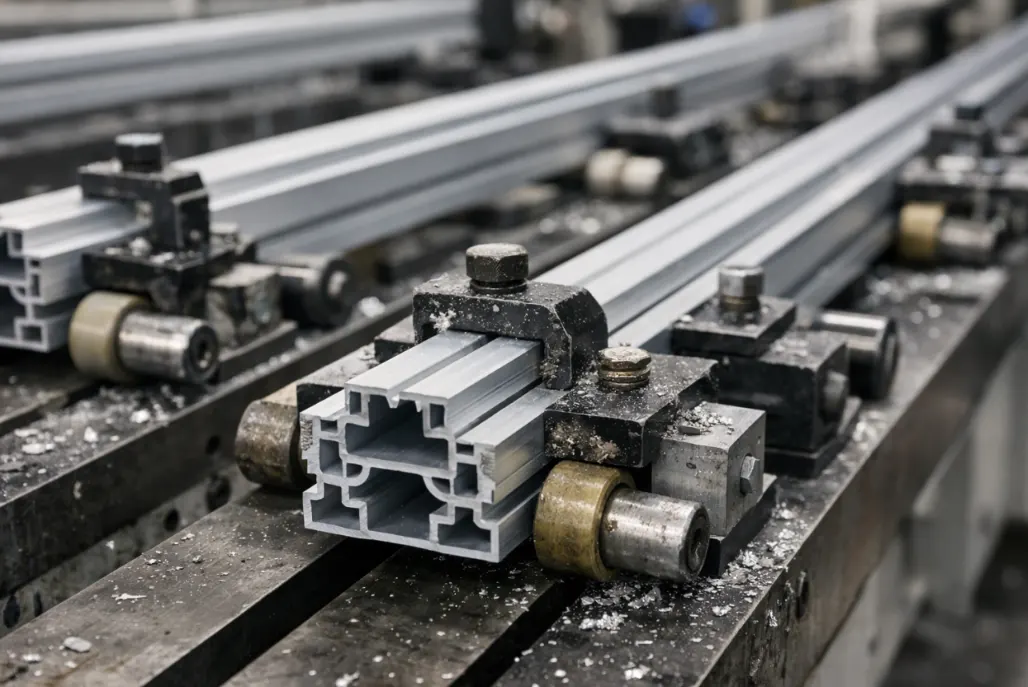
Clamping is not binary. It is a contact condition. Over a run, clamp pads pick up aluminum smears. Locating faces collect chips. A burr left from a prior cut can hold the part off the stop by a hair. That hair becomes 0.1 mm. Then it becomes a pattern.
Common trap is cleaning only when results look bad. By then, several parts have already drifted. A simple habit helps: clear chips from the same reference faces at a fixed interval. Not “when needed,” but every 10 or 20 cycles, depending on chip load and profile geometry.
Thermal Drift in Long Aluminum Profiles
Aluminum moves with heat. So does the machine. Early in a run, the machine warms and dimensions can shift. Long profiles magnify this effect, especially when the part overhangs supports. Even if the toolpath is correct, the real cut can change as the system reaches thermal balance.
If the first ten parts are measured at one temperature and the next fifty are measured after the shop warms up, results can look like “bad material.” Often it is just a different thermal state.
Material Variability Is Often Misdiagnosed
Material variation exists. Extrusion batches can differ in microstructure, surface condition, and local hardness. Forums are full of examples where a cutter suddenly “feels” a hard spot or the finish changes in a short section. That experience is real. The mistake is treating material variability as the only explanation.
Hard Spots, Surface Behavior, and Tool Response
In aluminum profile work, a local change in surface behavior can alter chip formation and finish. You may see a patch that machines with a different sound, a different burr, or a different sheen. That does not always mean the alloy is wrong. It can mean the process has little margin.
A process with strong referencing and stable clamping will often absorb small material differences. A process that relies on perfect seating will expose them. The same “hard spot” becomes a crisis only when the setup is already on the edge.
Why Material Differences Expose Process Weakness
If batch consistency only exists with one “good” extrusion lot, the process is not robust. In practice, you want the workflow to tolerate normal variation: mild surface differences, small straightness changes, slight profile twist. Those are common in long extrusions. They should not break production.
Re-Clamping and Re-Referencing Destroy Batch Repeatability
Re-clamping is where repeatability goes to die. It is not because operators are careless. It is because repositioning is never identical across a run, especially with long parts and multiple operations.
Why Manual Repositioning Is Never Identical
The profile may contact the stop with a slightly different force. Clamp closure can occur at a marginally different point, and a support roller may end up under another rib. Each change is small. In a batch, the sum becomes measurable. That is why the same program can produce two different “centers” of distribution: early parts cluster in spec, later parts drift to one side.
How Reference Loss Multiplies Over a Batch
Every time you rebuild a zero, you add uncertainty. A new reference can be close, but close is not equal. This is also where length issues sneak back in. If you need a refresher on the mechanics of drift after the saw step, link this topic back to your parent piece on length accuracy after cutting. Batch problems often start as reference problems.
Why Mid-Run Adjustments Usually Make Things Worse
When a batch starts to drift, the instinct is to “correct” it fast. That instinct is expensive. Mid-run tweaks can split a batch into sub-batches, each with its own offset logic. Later, inspection finds mixed behavior and nobody trusts the numbers.
Chasing Measurements Instead of Stabilizing the Process
If you adjust stops, offsets, or clamp habits based on a few parts, you may be reacting to noise. A better approach is boring: pause, clean reference faces, check fixture contact points, and verify the same datum is still the datum. It is less dramatic than changing parameters, but it tends to work.
Consistency Needs Fewer Decisions, Not More
Batch stability improves when the process removes human judgment calls. Fewer “maybe this is better” moments. More fixed, repeatable actions. In aluminum profile cnc machining, that usually means reducing re-clamps and keeping one coordinate system for as many operations as possible.
Process-Level Control Is the Only Reliable Fix
If your batch consistency aluminum profile machining problem persists, treat it as a system issue. The most reliable fix is to redesign the flow so the part stays referenced, supported, and clamped in a controlled way from start to finish.
Single-Setup Machining Reduces Batch Drift
When cutting, drilling, milling, and tapping happen in one setup, cumulative variation drops. You remove repeated seating errors. You also reduce inspection burden because the process itself becomes more predictable. The shop feels calmer. People stop “listening” to the machine for signs of trouble.
Why Integrated Profile Machining Supports Batch Stability
In many production lines, batch consistency improves only after moving to a solution that reduces re-clamping and keeps a stable reference across the run. That is where a dedicated profile machining center becomes relevant. The value is not hype. It is fewer breaks in the process, fewer rebuilt zeros, and better repeatability when volume rises.
Signs Your Batch Consistency Problem Is Structural
Some signals are obvious. Scrap rises. Rework becomes normal. Others are subtle. Operators start “compensating” without writing anything down. Inspection adds more checks because trust drops.
When Scrap Looks Random but Patterns Exist
If failures appear on the 30th to 60th part, or only after tool changes, the problem is not random. It is triggered by a repeatable condition: chip packing, clamp glazing, thermal state, or repositioning during long-part handling.
Why Scaling Production Exposes Hidden Instability
Low volume hides weak processes because attention can cover gaps. At scale, attention becomes a cost. That is when process-level control matters most. The goal is repeatability that does not depend on the “best operator” being on shift.
Conclusion
Batch consistency is not a slogan. It is a process property. When batch variation shows up in aluminum profile machining, the root cause is often a mix of fixture contact changes, thermal drift, material variability with low margin, and repeated re-referencing. The fix is rarely a new offset. The fix is fewer re-clamps, stronger referencing, and a workflow built for repeatability from part one to part five hundred.
A Practical Supplier for Profile Machining Stability
Foshan Malide Intelligent Equipment Co., Ltd. (MALIDE) focuses on intelligent equipment for aluminum profile processing, including profile machining centers, horizontal profile machining centers, profile cutting saws, and automated lines used in system windows, curtain walls, and industrial profile production. The company’s engineering approach targets shop-floor pain points that drive inconsistency: repeated clamping, unstable referencing, and fragmented operations across multiple stations. MALIDE supports customers with equipment that fits long-profile workflows, where batch repeatability matters as much as speed. If your production targets include tighter dimensional stability across runs, lower rework, and fewer “operator-dependent” outcomes, MALIDE’s profile machining solutions are designed around that reality.
FAQ
Q1: Why do the first ten parts look fine, then the batch drifts?
A: Early parts benefit from clean contact surfaces and a stable setup. As chips build up, clamps glaze, and the machine warms, small changes start to stack and drift becomes visible.
Q2: Is batch inconsistency usually caused by bad aluminum material?
A: Material variation exists, but it is often blamed too early. A fragile setup will turn normal variation into defects. A robust process will often absorb it.
Q3: What is the fastest check when batch variation shows up mid-run?
A: Stop and inspect the basics: datum faces, chip packing on locators, clamp pad condition, and whether the same reference is still used for every operation.
Q4: Why do mid-run adjustments sometimes make results worse?
A: Quick tweaks can split one batch into multiple behaviors. That creates mixed measurement results and makes diagnosis harder. Stabilizing the process usually beats chasing numbers.
Q5: When does it make sense to move beyond a multi-station workflow?
A: When re-clamping and re-referencing become the main source of variation, and inspection or rework becomes routine. Single-setup or integrated machining is often the cleanest way to regain repeatability.


