



Why Aluminum Profiles Lose Length Accuracy After Cutting
Just image you cut a batch of aluminum profiles to length, and the first few pieces look fine. Then the numbers start to drift. One part is 0.3 mm long, the next is 0.6 mm short, and suddenly the “same program” feels like a moving target. In most shops, this is not a blade problem. It is a process problem that shows up after cutting, when the profile gets moved, re-clamped, and machined in steps.
Length Problems Rarely Start at the Blade
A saw cut can be clean and repeatable, yet your final length still ends up off. That sounds unfair, but it is common in profile work. Cutting is only one event. The bigger risk comes later, when the part leaves its original reference and you start “building accuracy” again with stops, rulers, and operator judgment.
Why the First Cuts Often Look Accurate
On the saw, you usually have one stop, one clamp action, and one measurement target. The part stays in one place until the cut is done. That makes the first result feel stable, even if small positioning errors already exist.
Why Errors Show Up After Secondary Operations
Once you drill, mill, tap, or trim ends in separate steps, the profile is no longer controlled by a single reference. Every move becomes a chance for a tiny shift. A tiny shift repeats, and the final length becomes the sum of many small “almost right” actions.
Reference Loss Creates Length Drift
If you want one phrase that explains most length deviation in aluminum profiles, it is reference loss. When your original zero point is gone, you rebuild it. Rebuilding is never as repeatable as keeping it.
What Reference Loss Looks Like on the Shop Floor
It happens when a profile leaves the stop, gets flipped, gets reloaded, or gets re-clamped for another operation. You may use a tape, a scale, or a new stop block. The part looks “back to position,” but the coordinate system is not the same as before.
Why Long Profiles Magnify Small Mistakes
Length drift grows with distance. A slight angle error at the clamp can turn into a visible length error at the far end. Long work also reacts more to temperature. Aluminum expands about 0.14 mm per meter per 10°C. On a 6 m extrusion, a small shop temperature swing can move length by close to a millimeter. That is not a theory. It is why the morning shift and afternoon shift sometimes argue about whose tape measure is “wrong.”
Re-Clamping Multiplies Small Errors
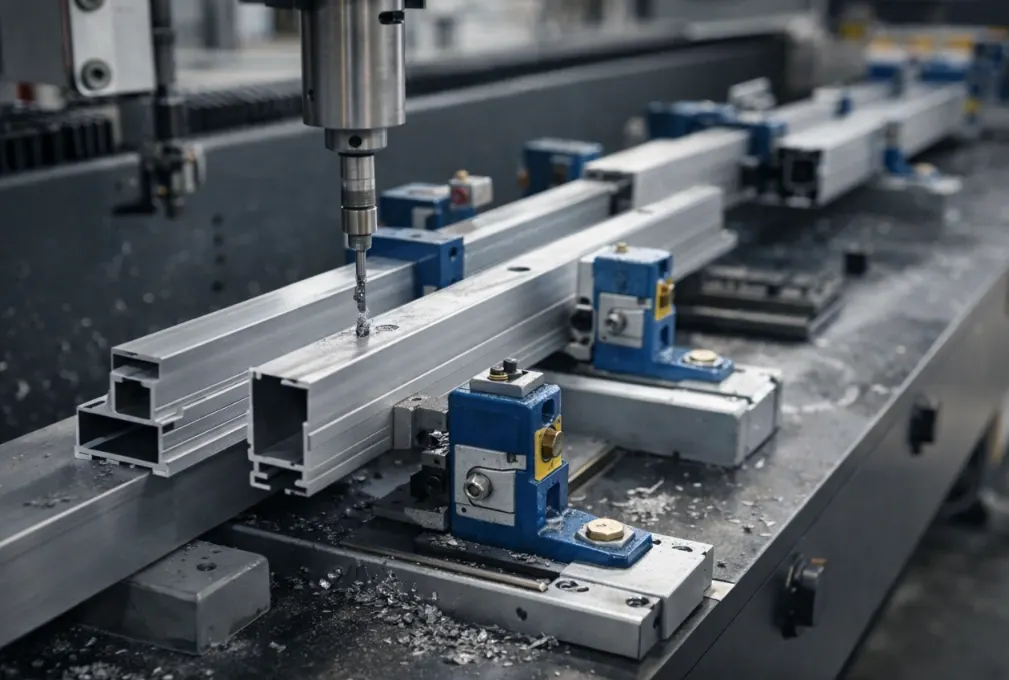
Most shops accept re-clamping as normal. The hidden issue is repeatability. A repeatable clamp action needs the same contact points, the same force path, and a clean seating surface. Real life adds chips, burrs, and rushed loading.
Why Manual Repositioning Breaks Batch Consistency
Even skilled operators cannot place every piece in the exact same way when the workflow depends on feel. A chip under a locator, a slightly different push into the stop, or a clamp pad sitting on a burr can shift the part by 0.1 mm. Do that three times in a process chain and you can “earn” 0.3 mm of deviation without noticing.
Why Extra Measuring Does Not Fix the Root Cause
More checks help you catch errors earlier, but they do not remove the source. Measuring is a filter. It is not a stabilizer. If the process keeps rebuilding reference points, you keep chasing numbers. That is when inspection time grows, and the line slows down for reasons nobody likes to admit.
Machining Length Limits Force Process Breaks
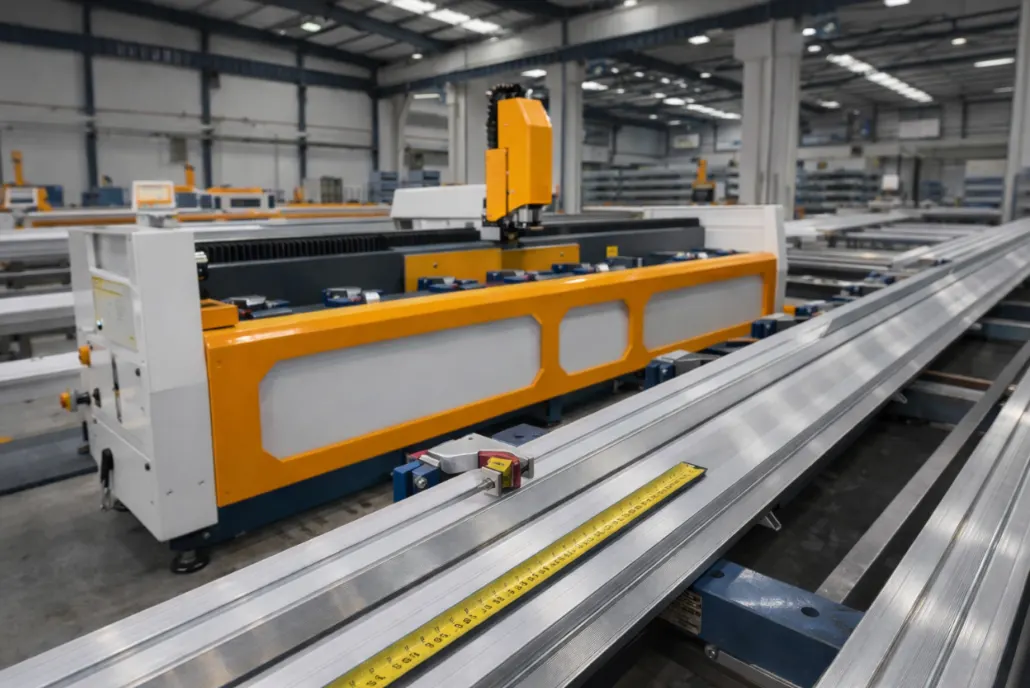
Another cause sits in plain sight: machine travel and bed length. Many extruded aluminum bars in real production run around 6 to 12 meters, and not every machine can support a single continuous setup across that range. When the machine cannot cover the full machining length, the process fragments.
How Travel Limits Create “Two-Stage Accuracy”
If you must machine one section, then shift the profile and machine the rest, you create two coordinate worlds. The shift point becomes your weak link. Even if each stage is accurate, the transition can add mismatch.
Why Splitting Work Increases Length Deviation
Splitting is not always wrong, but it raises the demand on fixturing and referencing. If your fixtures do not repeat within your tolerance window, you see step errors, cumulative drift, or end-to-end length mismatch. In curtain wall or window production, that can show up as assembly gaps that “should not exist” on paper.
Why Quick Fixes Stop Working
It is tempting to treat length drift as a tuning problem. Shops try new blades, tweak feeds, tighten clamps, and add check points. Those actions can help, but only when the root cause is actually on the saw or in a single setup step.
Blade and Parameter Tweaks Only Treat Symptoms
A better blade can reduce burrs and deflection. It cannot fix reference loss after the part leaves the saw. If length deviation grows after drilling or milling, the blade is not the main actor anymore.
Operator Skill Cannot Replace Process Design
Training matters. Still, no person can deliver machine-level repeatability across hundreds of cycles when the workflow depends on repositioning and judgment calls. If your output depends on “the good operator,” you already have a risk problem, not just a speed problem.
Equipment Level Fixes That Hold Length
When you need stable aluminum profile length accuracy across batches, the most reliable fix is to reduce reference rebuilds. That pushes you toward single-setup work and controlled repositioning, where the machine, not the operator, defines the reference.
Single Setup Machining Reduces Cumulative Error
If cutting, drilling, milling, and tapping happen with one clamping logic and one coordinate system, you remove several error doors at once. You also cut the time spent re-checking and re-squaring. The work becomes boring in a good way.
Why Profile Machining Centers Prevent Length Drift
A dedicated solution is to move from separated stations to an integrated process. In many profile workshops, that is where a profile machining center fits. The point is not “faster at any cost.” The point is stable referencing, fewer re-clamps, cleaner chip handling, and repeatable motion across long runs.
When It Is Time to Change the Process
You do not need a dramatic failure to justify a change. The shift usually starts with small signals that repeat every week, then every day.
Signs Your Cutting Workflow Has Reached Its Limit
Look for rising rework, growing inspection time, frequent stop adjustments, and batch-to-batch mismatch even when material and drawings stay the same. If the team spends more time “making it behave” than producing, the process is asking for a new structure.
Why Length Accuracy Becomes a Scaling Problem
At low volume, you can correct drift with attention and extra checks. At scale, drift becomes expensive. Scrap climbs, assembly slows, and delivery dates become fragile. That is when equipment level fixes stop being a luxury and start being a cost control tool.
Conclusion
If you keep seeing length deviation in aluminum profiles after cutting, the saw is often the least interesting part of the story. Reference loss, re-clamping, travel limits, and fragmented operations drive most drift. The cleanest path back to consistent output is fewer reference rebuilds, tighter fixturing logic, and a process that holds the coordinate system from start to finish.
Where MALIDE Fits in Real Profile Workshops
Foshan Malide Intelligent Equipment Co., Ltd. (MALIDE) focuses on intelligent equipment for aluminum profile processing, with product lines that cover profile cutting saws, profile machining centers, horizontal profile machining centers, and automated profile lines. Founded in 2017, MALIDE combines R and D, manufacturing, sales, and service, with a production base around 6,000 m² and a team that includes experienced engineers who work from real shop constraints, not lab demos. The company’s solutions are widely used in system windows, curtain walls, industrial profiles, rail transit, and photovoltaic structures, where long parts and repeatable tolerances are daily requirements. If your goal is fewer re-clamps, steadier dimensions, and a workflow that stays stable across batches, MALIDE’s equipment approach is built around that reality.
FAQ
Q1: Why does length drift get worse later in the shift?
A: Temperature changes, chip buildup, and small changes in clamping habits add up. On long profiles, even a modest temperature swing can move length enough to matter.
Q2: If the first cut is accurate, why is the final part still off?
A: Cutting can be accurate while later steps rebuild the reference point. Re-clamping and repositioning are where length deviation often starts to grow.
Q3: Can better measuring tools solve inconsistent cut length?
A: Better tools help you catch problems faster. They do not remove the cause. If the workflow keeps reloading and re-zeroing the profile, you still get drift.
Q4: When should you move from a saw based workflow to a machining center?
A: When rework, inspection time, and batch inconsistency become regular costs. If the process depends on constant adjustments, the system is telling you it needs a new structure.
Q5: What is the simplest way to reduce length deviation in aluminum profile machining?
A: Reduce the number of times the part leaves its reference. Fewer re-clamps and more single-setup operations usually produce the biggest jump in stability.


