



Solving the “Sticky” Aluminum Problem: How to Prevent Chip Buildup and Burrs in High-Speed Milling

Imagine you start cutting a batch of aluminum profiles. At first, everything sounds good. The cuts are crisp. But then, the sound changes. It starts to hum. Then, it screeches. You stop the machine to check the tool. It looks like someone dipped it in melted silver. The cutting grooves are totally blocked with welded metal. Plus, the edge of your part looks rough and messy.
We call this the “Sticky Aluminum” problem. Steel breaks into nice, clean chips. Aluminum is different. Especially soft types like 6063, which we use a lot for windows. It wants to melt. It wants to stick to your cutter. This isn’t just bad luck. It is simply physics. If you are having trouble with machining aluminum sticking to tool surfaces or you see constant burrs, you need to fix how you handle heat. You also need to change how you cut.
The Root Cause: Built-Up Edge (BUE) and Heat
To fix this, you have to know what you are fighting. It is called Built-Up Edge, or BUE. This happens when there is too much pressure and heat. The aluminum actually bonds to the carbide of your end mill.
Heat is the main bad guy here. Aluminum melts easily. If you make friction but don’t get rid of the heat, the metal stops cutting cleanly. Instead, it starts smearing. It rubs and melts. A tiny layer of aluminum sticks to your tool. This changes the tool’s shape. Your sharp tool gets dull. Friction goes up. Heat goes way up. This cycle goes faster and faster. Soon, the tool snaps, or your part is ruined.
Tooling Strategy: Flutes and Coatings
Your first defense is the end mill. Many people fail because they use a normal tool made for steel. That doesn’t work well for aluminum.
Flute Count Matters
Less is better. For aluminum, you need room for chips to get out. A 4-flute cutter packs chips too tight. It clogs instantly. To prevent aluminum burrs, stick to 1-flute, 2-flute, or at most 3-flute end mills. These tools have deep valleys between the blades. This lets a lot of chips escape easily.
The Wrong Coating
Never use AlTiN (Aluminum Titanium Nitride) coatings. Aluminum likes to stick to coatings that have aluminum in them. Using AlTiN is like putting Velcro on your tool. Instead, try these:
-
ZrN (Zirconium Nitride): It is hard and slippery.
-
DLC (Diamond-Like Carbon): This has very low friction.
-
Uncoated & Polished: This is often the best choice for soft alloys. A super shiny carbide surface gives the sticky metal nothing to hold onto.
The “Chip Evacuation” Factor: Coolant and Air
Even a great tool will fail if chips stay in the way. Recutting chips—where the tool slices through trash it just removed—is the top reason for rough finishes and built-up edge aluminum.
You must clear chips fast. If not, they get crushed between the tool and the wall. This makes huge heat. For profile machining centers, coolant for aluminum milling does more than lubricate. It moves the waste out.
-
Flood vs. Mist: Flood coolant is good. But many profile machines use MQL (Minimum Quantity Lubrication). Or they use a high-pressure alcohol mist. This keeps the workspace clean.
-
Aim is Everything: Point your nozzles right at the tool tip. That is where the cutting happens. If the air hits the tool handle, it won’t stop the heat at the edge.
Feeds and Speeds: Don’t “Baby” the Cut
When things go wrong, you might want to slow down. But with aluminum, slowing down is often a killer mistake. It creates a “rubbing” effect.
If your feed rate is too low, the edge rubs the metal. It doesn’t cut it. Rubbing makes heat. It doesn’t make a chip to carry that heat away. To find the right feeds and speeds for aluminum extrusion, you usually need to push the machine harder.
-
High RPM: Aluminum likes speed. Small tools (under 12mm) often do best at 12,000 to 20,000 RPM.
-
Aggressive Feed: Keep the tool moving. A thick chip takes heat away. This leaves the workpiece cool.
Machine Rigidity and Vibration
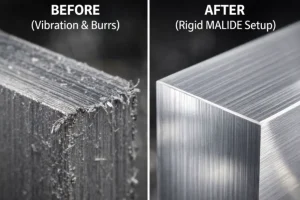
Sometimes, the tool isn’t the problem. The code isn’t either. It is the machine spindle. Burrs often show up where the tool shakes. If your machine isn’t stiff enough, the tool bounces off the surface. This makes a ragged edge. Then you have to fix it by hand.
This links closely to aluminum profile cutting accuracy. If your spindle wobbles, one blade hits harder than the rest. This wears it out fast. The surface looks bad. You need a stable spindle. It lets you keep those fast speeds we talked about without shaking.
Beyond the End Mill: The Role of Machine Stability
Fixing sticky chips and burrs takes more than a better end mill. You need a machine built for speed. It must handle aluminum without shaking. The machine itself is often the limit.
Foshan Malide Intelligent Equipment Co., Ltd. builds machines just for this. Some light routers shake when working hard. MALIDE is different. They use high-torque profile machining centers. These have rigid spindles. They give you the stability to push fast feed rates. They also have spray cooling systems built in. This blasts chips out of deep holes instantly. These machines stop heat before it builds up.
Maybe you mill complex window hardware. Maybe you make precise car parts. Partnering with a specialized manufacturer of intelligent aluminum equipment helps. It makes your process better from the start. MALIDE focuses on strong structures. This means you get a pile of clean chips. You get a mirror finish. You don’t get a sticky mess.
FAQ
Q1: Can I use WD-40 as a coolant for aluminum?
A: In a pinch or for manual work, yes. It prevents sticking. But for CNC production, it is a fire hazard. It also costs too much. You should use proper cutting fluid or special oil made for aluminum.
Q2: Why do I get burrs only on the bottom edge of the profile?
A: This usually happens when the tool exits the material. We call this “breakout.” The material has no support, so it bends away from the cutter. Try a “down-cut” (climb milling) strategy. Or use a compression end mill that pushes chips inward.
Q3: How often should I change my tool to prevent burrs?
A: Don’t wait for it to break. Listen to the sound. As soon as the “hum” turns into a “rattle,” the edge is getting dull. A dull edge pushes material. It doesn’t cut it. This guarantees burrs.
Q4: Is high RPM always better for aluminum?
A: Usually, yes. But your feed rate must keep up. High RPM with low feed equals burning and rubbing. You must keep a proper “chip load.” This means the chip needs to be thick enough to hold the heat.
Q5: My chips are long and stringy. Is that bad?
A: Yes. We call that a “bird’s nest.” It is dangerous. It wraps around the spindle. It blocks coolant from reaching the cut. You want tight, C-shaped chips. If they are stringy, increase your feed rate to break them.


