



Manual vs. CNC Aluminum Fabrication Cost Analysis for Window Factories
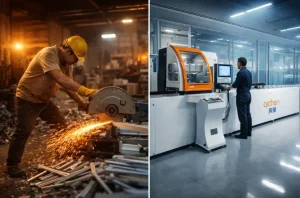
You are staring at the monthly production report. The orders are there, and the demand for high-quality aluminum windows is growing, but your profit margins remain thin. It’s a common frustration for factory owners. You walk onto the shop floor and see skilled workers measuring profiles, adjusting saw angles by hand, and double-checking drill points. It looks busy, but is it profitable?
The debate between manual methods and automation isn’t just about “new technology.” It is a math problem. Sticking to manual processing feels safe because the initial equipment cost is low. However, when you calculate the hidden costs of labor, scrap, and rework, the picture changes. This analysis looks at the real financial impact of your production choices.
The Hidden Costs of Manual Fabrication
Relying on manual tools often creates a false sense of economy. You see a low monthly equipment payment, but you might miss the money leaking out through operational inefficiencies. These costs don’t show up on a receipt, but they eat directly into your bottom line every single day.
The Labor Trap
Finding experienced fabricators is harder than ever. In a manual setup, your production speed depends entirely on the physical stamina and skill of your team. If your best saw operator calls in sick, production slows down. If he retires, you are in trouble.
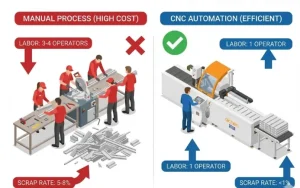
You are paying for more than just cutting time. You are paying for the time spent walking between machines, the time spent measuring, and the time spent clamping material. A manual workflow usually requires three or four people to match the output of a single operator running an automated line. That is three extra salaries, three extra insurance premiums, and three times the risk of human error.
Scrap Rates and “Human Error”
Aluminum profiles, especially thermal break systems, are expensive. In a manual environment, variability is unavoidable. Aside from simple measuring errors, many shops suffer from common mistakes in manual sawing—like improper clamping pressure or using the wrong blade speed—that ruin the workpiece often without the operator realizing it until assembly.
When you scrap a piece of aluminum, you lose the material cost, but you also lose the labor time already spent on that piece. If your scrap rate is hovering around 5% or 10%, that is thousands of dollars a year thrown into the recycling bin. Manual setups struggle to hold tight tolerances consistently over an eight-hour shift because people get tired. Machines don’t.
Manual vs CNC Machining: What’s the Real Difference?
It is easy to think of CNC (Computer Numerical Control) as just “faster,” but the difference goes deeper than speed. It changes how your factory flows. Comparing manual vs cnc machining is like comparing drawing a straight line by hand versus using a ruler; one requires constant focus and skill, while the other simply follows a guide.
Speed and Cycle Times
In a manual shop, drilling a lock hole involves measuring, marking, center-punching, and then drilling. It takes minutes. On a CNC machining center, the spindle moves to position and drills the hole in seconds.
The real speed gain comes from grouping tasks. A CNC machine can drill, mill slots, and tap holes in a single clamping operation. You don’t need to move the profile from a saw to a drill press and then to a copy router. The material stays still, and the machine does the work. This cuts down the “handling time”—which is where most production bottlenecks actually happen.
Handling Complex Angles and Accuracy
Window designs are getting more complicated. Architects want odd angles and custom shapes. If you are using a manual chop saw, changing the cutting angle from 90 degrees to 45 degrees requires stopping work. If that angle is off by even half a degree, the window corner won’t join correctly. Achieving consistent aluminum profile cutting accuracy across hundreds of cuts is physically demanding for any human operator, but it is standard procedure for a machine.
To eliminate these setup inefficiencies and guarantee angular precision, many factories are switching to advanced profile cutting saws. These machines allow for continuous cutting where the blade angles change automatically via the program, removing the need for manual intervention and the risk of bad cuts.
The Data: Comparison of Efficiency
Let’s look at the hard numbers. Subjective feelings about “craftsmanship” don’t pay the bills. When you line up the metrics side by side, the gap between cnc machining vs manual machining becomes obvious, especially as your order volume increases.
| Metric | Manual Processing | CNC Processing |
| Setup Time | High (Manual adjustments per batch) | Low (Load file and go) |
| Operators Needed | 3-4 (Skilled) | 1 (Semi-skilled) |
| Accuracy | +/- 0.5mm (Operator dependent) | +/- 0.1mm (Consistent) |
| Safety Risk | High (Hands near blades) | Low (Enclosed operation) |
| Scrap Rate | 5-8% Average | < 1% |
When Does the Switch Make Sense?
You don’t need CNC if you make five windows a week. But there is a tipping point. Usually, once a factory hits a consistent output where manual labor costs (including overtime) exceed the monthly financing cost of a machine, the switch is mandatory for growth.
Think about the “lost opportunity” cost. If you turn down a large commercial project because your manual team can’t meet the deadline, that is a direct loss caused by your equipment. A CNC machine allows you to say “yes” to larger orders without panicking about hiring temporary staff.
Partnering for Production Success
Deciding between cnc vs manual machining ultimately comes down to your long-term business goals. If you plan to scale up, improve quality, and stop worrying about daily production headaches, automation is the only logical path. However, buying the machine is just step one; you need a partner who knows the process.
Foshan Malide Intelligent Equipment Co., Ltd. stands out as a specialized partner for aluminum fabricators. Located in Foshan, the heart of China’s aluminum industry, MALIDE doesn’t just ship boxes of iron. They build integrated solutions, from heavy-duty saws to high-precision machining centers specifically designed for window, door, and curtain wall manufacturing.
What makes MALIDE different is the focus on “factory-ready” equipment. They know that a machine is useless if it’s hard to operate. Their equipment—like the QCJ series saws and QCL machining centers—is built with intuitive software and robust components (like Schneider electrics) to ensure reliability. They have exported to over 20 countries, bridging the gap between high-performance European standards and cost-effective manufacturing. When you choose a reputable aluminum intelligent equipment manufacturer like MALIDE, you get technical support that helps you get up and running fast, turning that ROI calculation into real cash flow.
FAQ
Q1: Is it difficult for my current workers to learn how to operate a CNC machine?
A: Not really. You don’t need a computer programmer to run these machines. Modern controllers are visual and designed for factory floor staff. Usually, a standard operator can learn the basics of loading profiles and starting the program within a few days of training.
Q2: How much space do I need for a CNC line compared to manual stations?
A: You might actually save space. While a CNC machine is large, it consolidates three or four manual stations (saw, drill, router) into one unit. Plus, you get rid of the piles of “work in progress” material stacking up between those manual stations, which clears up your floor.
Q3: What if the machine breaks down? Are spare parts hard to get?
A: This depends on the manufacturer. Reliable brands use standard international components (like guides, bearings, and electrical parts) that you can often find locally. For specific parts, a good supplier will ship via air express to minimize downtime.
Q4: Can a CNC machine handle different types of aluminum profiles?
A: Yes, they are versatile. Whether you are cutting slim window frames, heavy door sashes, or even industrial tracks, the machine adapts. You just need to change the clamping setup or call up a different program, which takes minutes rather than hours.
Q5: Will the maintenance cost be higher than my manual tools?
A: In absolute terms, yes, because the machine is more complex. However, manual tools break too—belts snap, motors burn out, and blades dull quickly due to unstable feeding. CNC maintenance is predictable and scheduled, whereas manual tool failures often happen unexpectedly in the middle of a rush job.


