



How Aluminum Profile Machining Lines Are Built: From Cutting to CNC
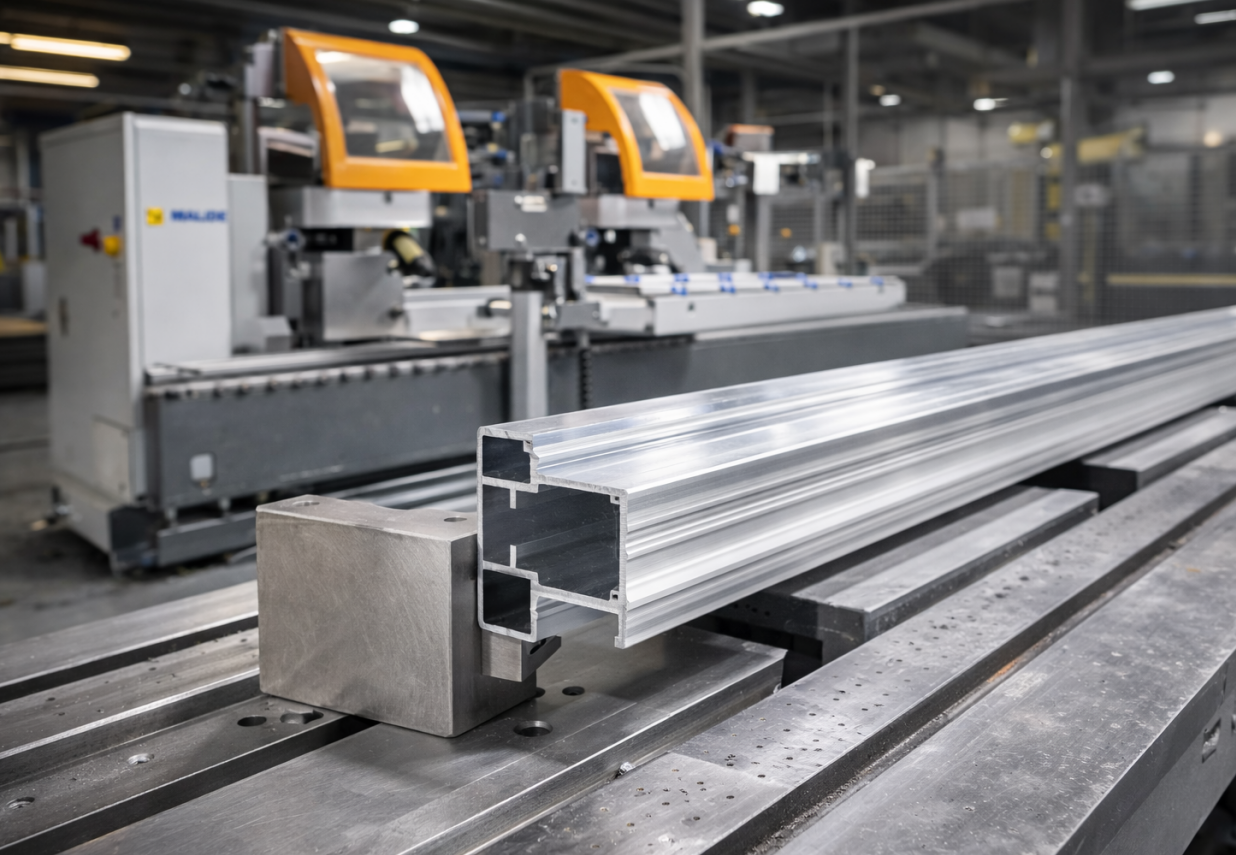
Machining line for aluminum profiles fails in a familiar way. Cutting reports look acceptable, the CNC program looks proven, and the first pieces can measure fine. Then the batch starts drifting. Operators begin nudging stops, tweaking offsets, and “saving” parts with clamp force. At that point, it is not a machine problem. It is a process-link problem.
If you are building an aluminum profile machining line, the job is to keep reference surfaces consistent from cutting to CNC. The line must protect datum continuity, control long aluminum profile support, and create feedback loops that correct issues at the right station instead of masking them downstream.
Define the Output First: Accuracy, Surface, and Throughput
A line design that starts with machines usually ends with compromises. The stable approach starts with outputs, because outputs define what must stay consistent across stations.
Lock three decisions early. First, identify which dimensions are truly functional. In window and curtain wall fabrication, that is often hole position relative to a critical face, end-face geometry for assembly, and flatness where sealing or mounting happens. Second, decide what surface quality is actually critical, so you do not “polish” features that do not matter. Third, define the throughput window you can hold with cycle time stability across shifts, without turning accuracy control into constant manual adjustment.
Once these are clear, layout choices stop being guesses. You know where control effort belongs and where it does not.
Cutting as the First Accuracy Operation
Many factories still treat cutting as preparation. In a line environment, cutting is the first accuracy operation. The cutting station defines what surfaces the next station will trust, and whether the part will sit consistently in a fixture.
Why End-Face Geometry Matters More Than Length
Length is easy to measure. But the machining station cares about how the part locates, and that depends on end-face geometry.
Three cutting outputs usually matter more than length alone:
-
End-face squareness to the profile axis
-
End-face flatness where the part contacts stops or pads
-
Burr and edge condition that changes seating
That is why a batch can pass length checks and still drift in CNC feature location. If the part contacts a stop differently each time, your datum moves. That movement becomes tolerance stack-up. If your workflow relies on consistent contact at the cut end, aluminum profile cutting accuracy must include geometry control, not only length control.
This is also where setup discipline matters. A production-ready aluminum profile cutting saw (or aluminium profile cutting saw in spec sheets) is not only about speed. It is about repeatable cut angle and end-face quality as blade condition and profile sections vary. That repeatability protects downstream datum transfer. (Internal link: profile cutting saw product page)
Supporting Long Profiles During Cutting
Long profiles amplify variation. If the profile is poorly supported during cutting, gravity and residual stress release can change the part state at the exact moment the end face is created. That end face then becomes the reference for machining.
Support should prevent sag, but it should not force straightness into a profile that wants to relax. If you “straighten” the part during cutting and then clamp it differently in machining, you create inconsistency by design.
Material Behavior That Affects Line Stability Without the Theory
You do not need a materials lecture, but you do need to respect what shows up in production.
Thermal effects matter on long profiles. Small temperature changes can shift length enough to complicate stop-based positioning and can change how a part settles on supports. Heat is a line issue because cycle time drift changes heat exposure, and heat exposure changes geometry.
Thin-wall sections also react strongly to clamp force and tool load. If your process “fixes” variation by clamping harder or slowing feeds to manage chips, you are changing part state and increasing scatter.
The practical takeaway is simple: treat heat and stiffness as amplifiers. Stable lines reduce the need for compensation.
Datum Transfer From Cutting to CNC
If you want consistent results, you cannot afford to keep “re-finding” the part at each station. You must transfer datum intentionally.
How Datum Is Lost Between Stations
Datum transfer breaks in predictable places. Parts are flipped or rotated without a controlled rule. Stops are contacted on burrs or inconsistent end faces. Handling adds small nicks that change seating. Staging mixes parts with different temperature histories. In the CNC station, clamps are tightened differently, changing how the profile settles.
None of these looks dramatic, which is why they survive. Combined, they create tolerance stack-up. A useful diagnostic is routine offset changes. If you are constantly adjusting to “make features land,” datum is not stable.
Designing for One-Datum Flow
A one-datum flow means you define a primary reference strategy early and keep it consistent through the process. That can mean locating off a controlled side face and using the cut end only as a secondary stop, or controlling end-face geometry enough that it can reliably serve as a reference.
The goal is to make machining a continuation of what cutting created, not a new interpretation of the part every cycle.
Fixturing and Support for Aluminum Profiles
Fixturing is where many lines drift into bad habits. When upstream variation exists, the fixture becomes a corrective tool instead of a locating tool. That usually increases distortion and reduces repeatability.
Support Spacing for Long Extrusions
Long profiles need support, but support must be repeatable. The objective is to prevent sag without forcing straightness. If support points are adjustable without a rule, operators improvise, and improvisation becomes variation.
This is a common reason CNC machining aluminum profiles looks unpredictable even with the same program: the toolpath is cutting a part that is “sitting differently” each time.
Clamp Force Versus Part Distortion
If your accuracy strategy depends on clamp force, you do not have an accuracy strategy. Over-clamping can distort thin walls, twist asymmetric profiles, and lock stress that releases after machining. The result is confusing: it measures fine while clamped, then fails after release.
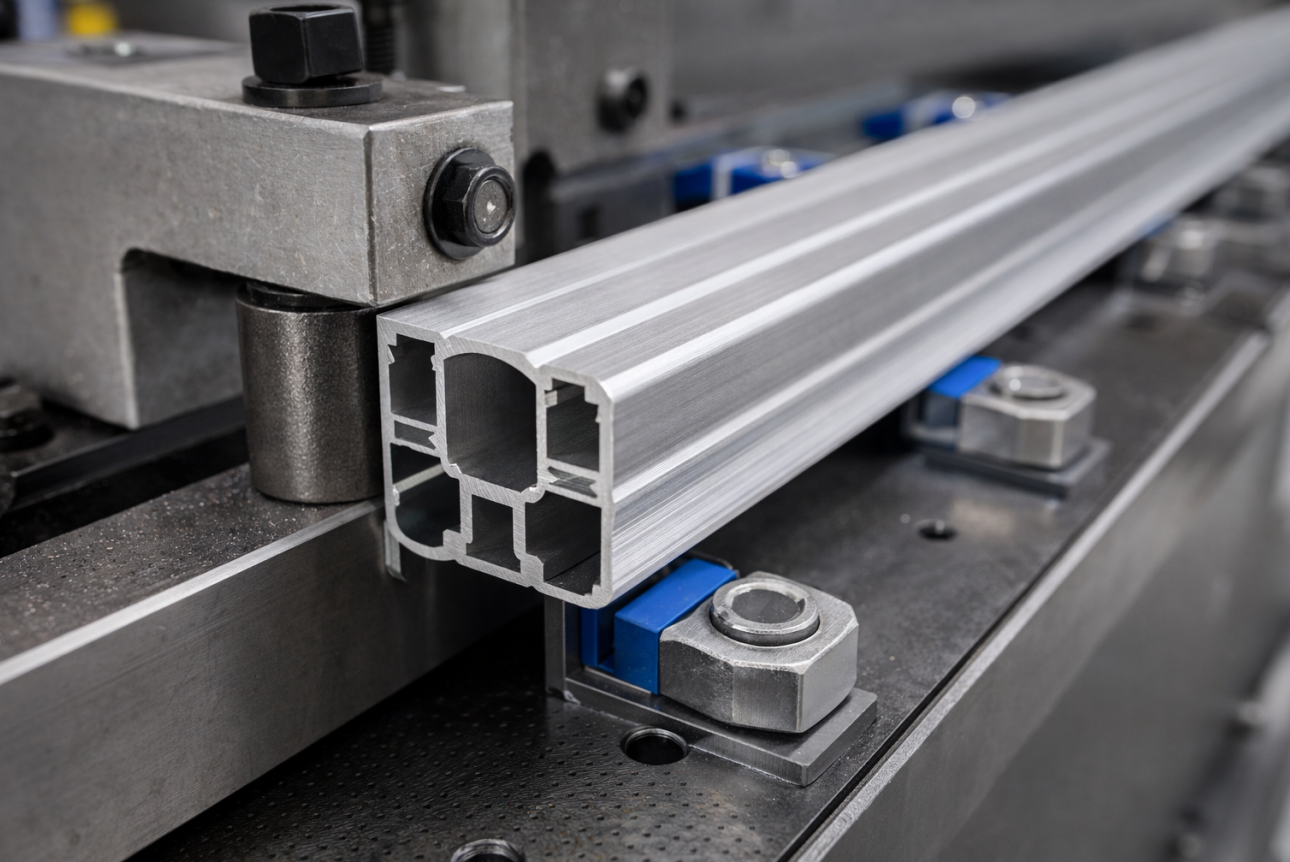
A stable approach uses consistent clamping sequence, controlled force, and fixtures that locate without fighting the extrusion. Fixturing aluminum profiles should be repeatable, not corrective.
CNC Station Design for Lineal Aluminum Profiles
A CNC station in a line is judged by stability across batches and shifts, not by a single perfect part.
Tool Access, Chip Evacuation, and Coolant
Chip control is not cosmetic. In aluminum, poor evacuation affects surface finish, tool load, and thermal behavior. When chips pack, operators slow feeds, pause cycles, or change coolant behavior. Each change shifts heat and repeatability.
Design for reliable chip evacuation, consistent coolant behavior, and minimal re-clamping.
What CNC Accuracy Means in a Line Context
In a line context, accuracy is mostly repeatability. If every batch needs offset changes, the line is absorbing upstream variation instead of controlling it.
An aluminum profile machining center configured for profile work, plus fixtures and loading built around datum continuity, usually delivers better line-level stability than a setup that relies on operator interpretation.
In-Line Measurement and Feedback Loops
A machining line becomes stable when it detects drift early and corrects it at the correct station.
Measurement should not be only an end-of-line audit. If you discover errors after full machining, correction cost is highest. Better is to measure the few variables that predict downstream failure. Sampling end-face squareness and burr condition after cutting can predict stop-contact consistency. First-piece verification at the CNC station confirms datum transfer before you run a full batch.
Feedback must follow an order. If cut geometry is drifting, fix cutting first. If seating is inconsistent, fix burr control and fixture contact points next. Offsets are the last lever, not the first. When offsets become routine, tolerance stack-up is already in control.
Commissioning and Scaling the Machining Line
Many lines look fine during trials and fail during scaling. Trials are controlled; production introduces variation in operator behavior, staging, and material state.
During commissioning, focus on repeatability more than speed. Confirm consistent locating, consistent support and clamp usage, and consistent orientation rules. Classify scrap by root cause, not by symptom. If holes are off, do not label it “CNC issue” by default. Trace whether datum moved between stations or whether the part state changed under clamping.
When scaling, control staging and interfaces. Mixed batches and temperature drift can look like machine instability. Automation loading unloading helps only when it preserves datum, not when it simply moves parts faster.
Conclusion
An aluminum profile machining line is not a row of machines. It is a continuity system. You create accuracy early at cutting, preserve reference surfaces through handling and fixturing, and maintain CNC repeatability without constant correction.
Build the workflow from cutting to CNC around datum continuity, stable support, and measurement-driven feedback. Do that, and you stop chasing offsets and start producing predictable parts.
A Practical Manufacturing Partner for Aluminum Profile Cutting and Machining
Line stability is not achieved by a single “better machine.” It comes from aligning cutting geometry, datum transfer, fixturing strategy, and CNC execution so variation does not accumulate into tolerance stack-up. MALIDE focuses on this system reality when developing equipment and solutions for aluminum profile processing.
In production, factories often see the same pattern: cutting looks acceptable, but CNC positioning becomes unstable once batches scale. MALIDE’s approach is to treat cutting and machining as a connected system, emphasizing end-face control at the cutting stage, setups that preserve reference surfaces into machining, and line configurations that reduce manual repositioning and repeated adjustments.
FAQ
Q1: What is the biggest difference between an aluminum profile machining line and a single CNC machine?
A: A single CNC machine can make accurate parts in isolation, but an aluminum profile machining line must keep accuracy stable across stations. The difference is datum continuity and controlled interfaces.
Q2: Why does CNC accuracy drift even when cutting length checks look fine?
A: Length checks do not guarantee stable locating. End-face squareness, flatness, and burr condition affect how the profile contacts stops and fixture pads. If contact changes, datum shifts and tolerance stack-up grows.
Q3: How do you prevent long aluminum profiles from sagging without distorting them?
A: Use repeatable support points that prevent sag but do not force straightness. Support spacing should match how the profile will be clamped and machined, so the part state is consistent cycle to cycle.
Q4: Should you fix line variation by adjusting CNC offsets?
A: Offsets should be the last lever. If offsets become routine, the line is absorbing upstream variation instead of controlling it. Fix cutting geometry drift, burr control, seating surfaces, or fixture contact consistency first.
Q5: Where should measurement happen in a machining line to catch problems early?
A: Use in-line measurement that predicts downstream failure without slowing the line: sampling end-face squareness and burr condition after cutting, plus first-piece verification at the CNC station to confirm datum transfer before full batches run.


